

As someone that is relatively new to being a Humanist, I was excited to attend the World Humanist Congress to see what Humanism looked like outside my Lowcountry group. As it turns out, it was very similar, just on a much larger scale.
I’m not going to talk too much about the travel part of the trip, but suffice it to say it was very similar to the 1987 movie Planes, Trains and Automobiles in both directions! We arrived too late to catch the kick-off event Friday night, but the rest of the weekend was magical. We found Ottawa to be a beautiful city, full of friendly, vibrant people. It was a fitting place for a humanist conference.
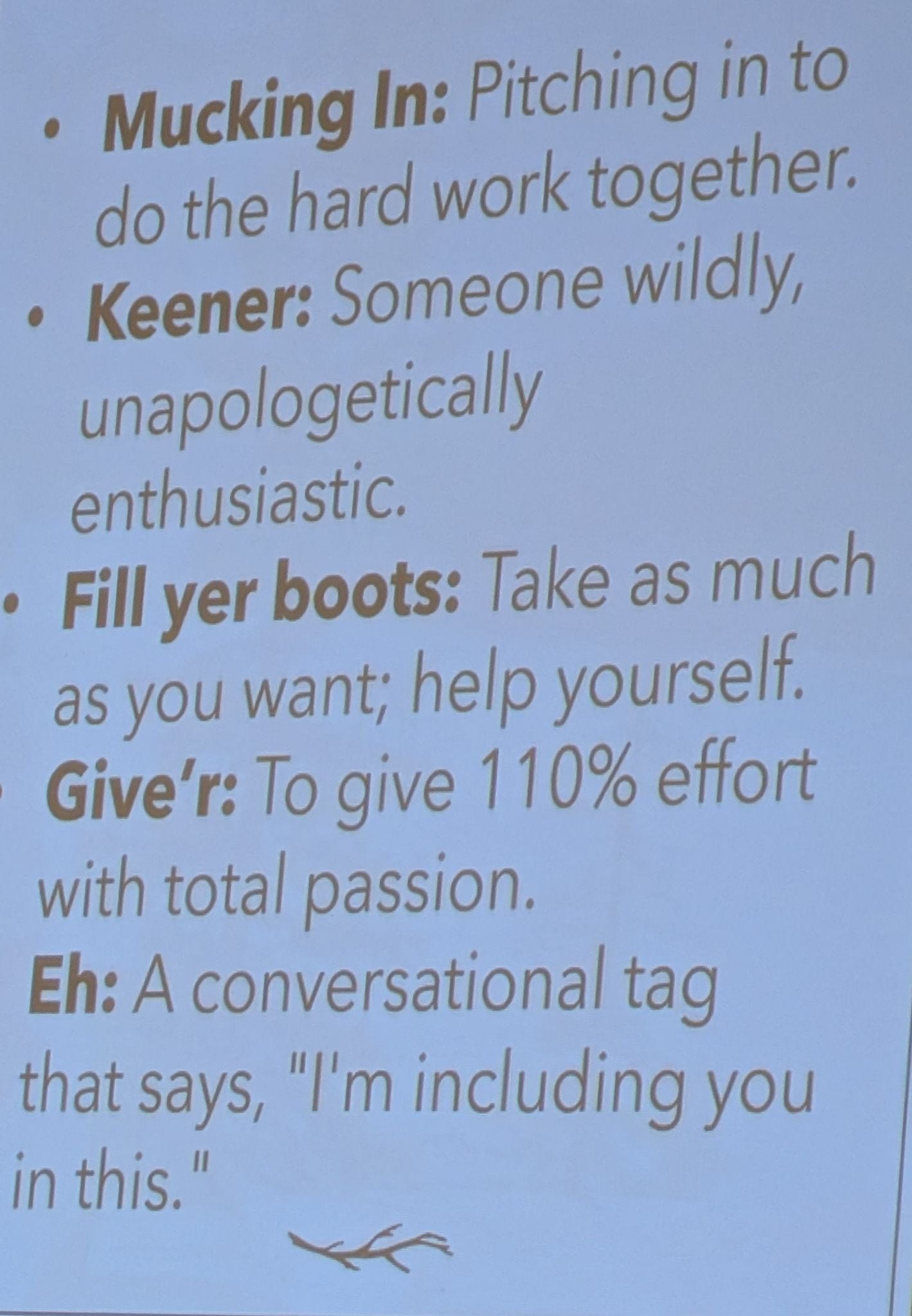
The Canadian Humanists were perfect hosts, even giving us a quick vocabulary lesson:
There were rooms full of people who practiced kindness and empathy like it was a job- and that’s pretty impressive, all on its own. But the theme of the conference was “Humanism As Resistance” and as someone who has made a full-time job of resistance for the last 10 years, this really appealed to me.
I’m not sure what I expected, but the sheer number of countries represented (41!) was astounding to me. I had no idea that humanism was so widespread throughout the world. I must not have been the only one who didn’t know this, because the first hour or so was spent discussing which of the different countries around the world had the highest percentage of non-religious people. The Netherlands, Great Britain, Estonia, Czechia, South Korea, China, Vietnam, and Thailand all had populations in which more than 50% identified as non-believers. The speaker explained that even in the US, the percentage of people who did not claim a religious denomination was 46%. This gave me a lot of hope about our little Christian Nationalism problem.
Some of my favorite quotes of the conference were (and I’m transcribing these from my chicken scratch notes, so there’s a fair chance I’ve muddled something up):
“Perhaps the most radical act of resistance in the face of adversity is to live joyfully” – Ari Honarvar.
“Rationality is not a gift; it is a tool of resistance that we must constantly sharpen against those who attempt to dismantle it from within” – W.K. Clifford
“There is no final victory, as there is no final defeat. There is just the same battle. To be fought, over and over again. So toughen up, bloody toughen up.” – Tony Benn
“Science tells us what’s real; Compassion tells us what’s right.” Fish Stark
One speaker told us “Humanism is my religion. Humanism is resistance because it insists that every human has an inherent dignity.” I think this speaks to the community we feel as humanists. We elevate each other, rather than a deity. Our commitment to empathy toward others calls us to listen and connect deeply with those around us, much like the congregation of a church, but without the dogma or deity. We do not need to be frightened or scolded into treating others well, we simply believe it is our duty to do so, as humanists.
He also insisted that we are either humanizing or dehumanizing someone with our actions toward them, and I had never quite thought of it that way. It’s something that I will try hard to remember in my dealings with people who think differently about the world than I do.
In that same vein, he also spoke of “modeling civility.” I had a bit of a harder time with this concept because it’s very hard to model civility when the other side is literally trying to kill you, or strip you of every right you have as an American. In the end though, he was correct when he said, “ We improve things through reason, empathy and persistence.” I wish I had written down his name so that I could give him credit.
Another speaker talked about having a menu of sorts for services like churches often offer but calling it “Humanist Existential Care.” We do a lot of mutual aid in our local group, but I love the idea of a “care menu” for our members and it’s something we’ve kicked around a few times.
Another concept spoken about at the conference was so simple yet so profound:
Goodness ≠ Religion.
As someone who was raised Catholic, I always believed that a trait of good people was that they were religious (and as a child, that they were Catholic!) I was never exposed to people outside of our religious circle-except occasionally by accident- until I was a teenager, and by then the indoctrination was nearly complete. Good people are everywhere, and many of them lost their religion a long time ago (or never had it at all!)
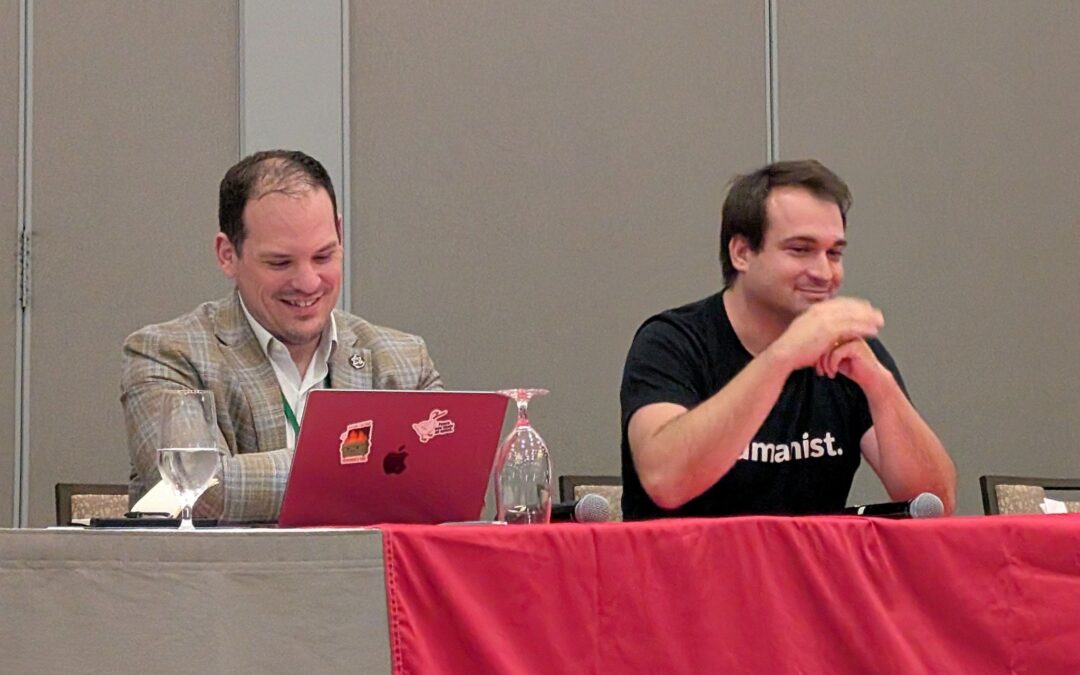
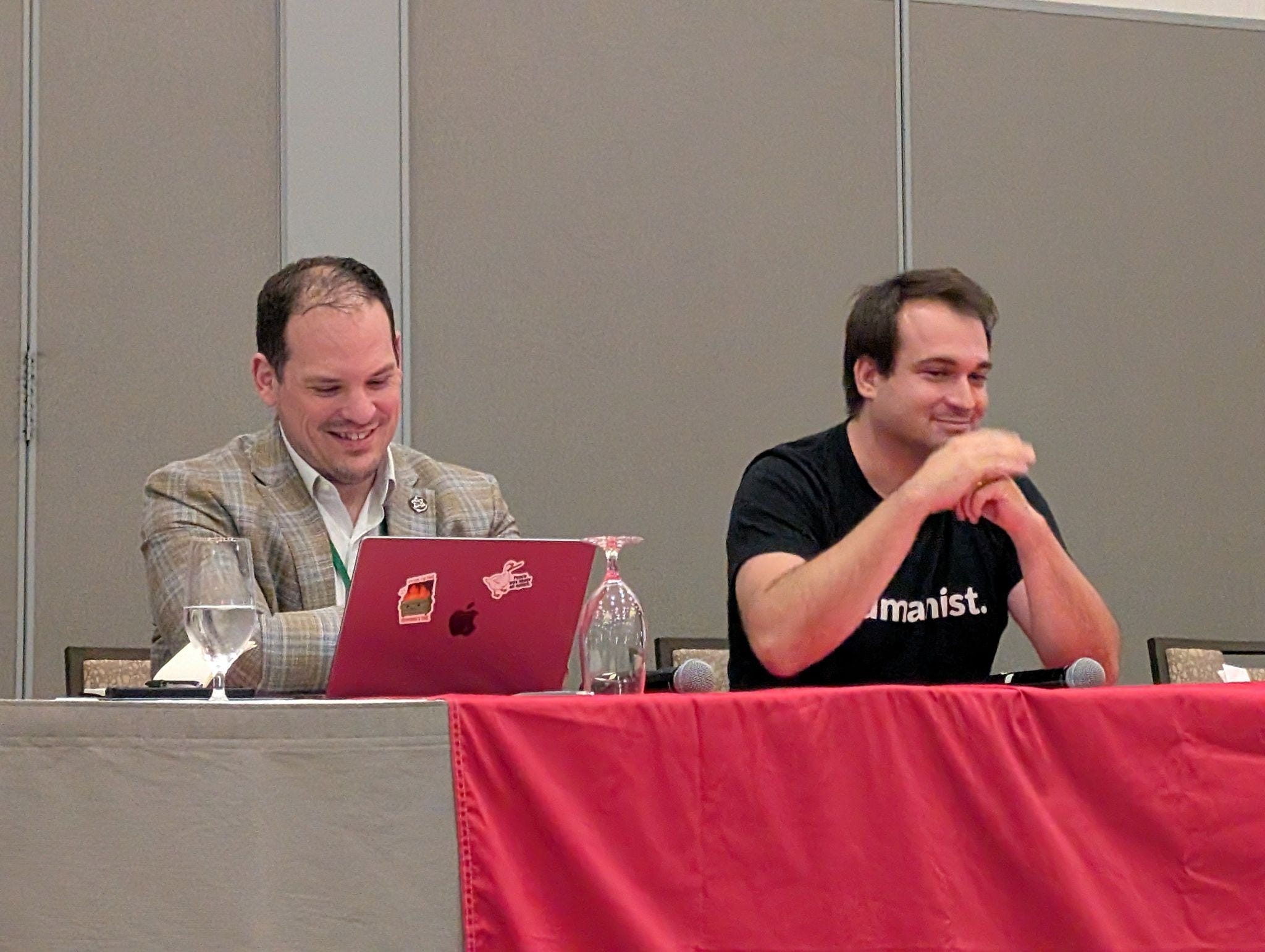
I finally got to meet the Famous Fishes- that is Nick Fish (American Atheist) and Fish Stark (American Humanist Association). Both were exactly how I had imagined them: kind, funny and passionate about their work. They had a lot of great things to say about Humanism as Resistance.
One lesson I have believed in for a long time but really enjoyed hearing out loud is that it is well past time for all of us to get involved in the hard work of civics. Like all important causes, “the best time was 20 years ago, but the second best time is NOW!” We need to step up and show up in places like school boards and library boards, where it all starts. As one of the Fishes said, it’s time for Humanists to be properly represented in our government. “Someone everywhere, at every level, in every seat!”
One speaker warned us not to shy away from politics, because “Humanism is political when institutions try to erode its values.” I would say that moment is now. Non-religious people are under attack in the United States and it’s time we fought back!
We heard from the amazing A.C. Grayling who spoke about Hope. Not that wishy-washy kind of hope, but a rational hope that leads to taking action. He spoke about taking political action on those things that were really important to us as Humanists, like the religious indoctrination of children (shameless plug: please run for the school or library board!)
He spoke about how Humanism is treating people the way we would a painting: put them in a good light, (until they prove themselves to be bad.) He emphasized that it is this life that matters, and we should care about people and treat them like it. He did caution us not to get complacent and to be vigilant of bad actors.
Lastly, he also emphasized the importance of critical thinking, what he called ”being skeptical in the right way.” Ask the question “Really?” when something sounds unbelievable and wait for an explanation that makes logical sense. If you don’t get one, well, there’s your answer– “no, not really!”
I left the conference with a toolkit of ideas and a re-ignited passion for resistance, this time with a Humanist twist. I learned skills from folks who are practicing Humanism as Resistance in places like Ghana, the Philippines and Romania, where resistance is not only difficult but dangerous. I came away realizing that Humanism as Resistance is not just important, but essential, and with a renewed sense of responsibility to the cause.